

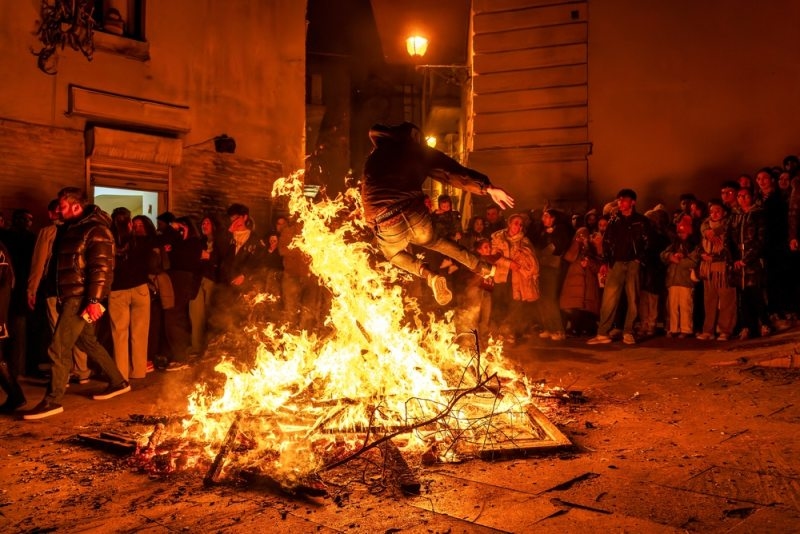
Chaharshanbe Suri is a lively and festive occasion before Nowruz, where families and communities are reunited around fire, meals, music, and their traditions. It is more than just a spectacle of colorful fires because it symbolizes abandoning struggles in favor of welcoming strength, health, and hope.
Its traditions have survived for many generations, and the event is an important part of the cultural celebrations leading up to the Persian New Year.
Commonly called the 'Persian Fire Festival,' this tradition is celebrated the evening before the last Wednesday on its way toward Nowruz. The origin of the name comes from Wednesday and 'celebration'; however, the celebration itself begins in the evening of Tuesday, and it is maintained all through the night. It originated in ancient Iran and has become closely linked with the concepts of fire, purification, and renewal.
The principal notion behind this tradition is fairly simple yet deep: people let their sickness, frailty, misfortune, and difficulties go away from their physical selves; they seek vitality and health in return and thus obtain strength.
The one tradition that stands out most prominently in the celebration is the fire jumping tradition, where people leap over fires which are generally made rather small for safety, whilst uttering a special chant, conveying a wish where all their negative energy is passed along to the fire and so is transferred to its own fiery force and warmth.
So people perform this jump not for sport, but as a psychological reset before starting a new beginning the very next year. The size of the flames has varied throughout the centuries, and while people in Iran do take the fire quite seriously, with grand outdoor festivities being rather common, Western societies tend to prefer more controlled, smaller fires or attend organized fire jumping events instead. Care must be exercised, as this Persian celebration has roots in renewal, not in destruction and danger.
Suggested Reading: Yalda Night Food Guide: Traditional Persian Recipes to Enjoy
Despite not being directly related to fire, numerous other Chaharshanbe Suri traditions complement it extremely well. For instance, there is the custom known as Qashoq-Zani or spoon-banging, where people disguise themselves, visit homes, knock on people's doors with a pot or a can at the end of a long spoon, and while hitting it repeatedly, their good fortune for the upcoming year is brought along.
Food also plays a large role, traditionally consisting of special dishes like Ash Reshteh (a delicious savory noodle soup) and Ajil (a mix of nuts and dried figs) served from many households throughout the region. This makes the Persian Fire Festival not only visually beautiful but also very tasty, inviting neighbors from miles around to join.
The event precedes New Year's in Iran by nearly a whole week, and therefore it naturally fits with the overall tradition of Iranian New Year customs. If Nowruz itself signals a completely fresh start and the beginning of springtime, this event traditionally represents the burning away of all evil before this event is truly ready. Both festivities go hand-in-hand.
There is quite a bit of variation in how the New Year customs manifest among Persians, especially immigrants scattered all across the West; however, the fire-jumping traditions generally remain a vital part, though perhaps miniaturized and celebrated differently. For the people residing in countries where such celebrations are not a part of the customs, families may still choose to enact it themselves by gathering over a safe fire, reciting the same ancient chant and sharing festive food.
This tradition takes various forms depending on geographical context today. Families and communities may observe it through public gatherings, private street celebrations, organized fire dancing performances, along with sharing delicious foods, music, and cultural dances. Such celebrations are proof that it can accommodate new approaches while retaining its essential components.
Today, families celebrating at home may opt for simply partaking in the main practices: saying the prayer or Chant in chorus while taking a step over a fire and partaking of the ajil, or eating a healthy traditional stew such as ash reshteh.
Safety in observation is therefore key, though still preserving the element of personal catharsis within the practice, which allows even older relatives and children the ability to take part in the event in comfort.
This tradition has undoubtedly become such a cherished festival through its unique ability to capture visually while deeply invoking something more emotional inside humans. Each and every one of us goes through difficult patches in life, and the notion that these experiences have been effectively banished with a burning fire, only to pave the way for better things, has become an exceptionally comforting idea over many generations.
Combined with family gatherings and food, these ancient concepts make this tradition not only a spectacle but a profound ritual that is shared with everyone around, symbolizing hope, togetherness, and health. Through all the variety in the different areas where it takes place, it's proven its flexibility and is serving an even more important purpose by joining all Persian factions around the world, and it is this meaning it offers that has made it stand far above all other Persian New Year's traditions.
Chaharshanbe Suri is more than just a spectacle with fires and festivity. While the tradition of jumping through flames helps rid past troubles and welcome prosperity, the feast of certain cuisines like Ash Reshteh, along with community involvement in qashoq zani, brings individuals of all ages together.
Among all the traditional symbols attributed to Persian New Year customs, this tradition alone does more than create a visible division between two days that may hold trouble with it as opposed to days with brighter dreams of the future, but also enables individuals to step into a new season with confidence and exuberance.
The flame represents warmth, life, purification, renewal, and the shedding of weaknesses while taking on new vitality. This tradition can best be remembered as a fire that brings with it strength and leaves weakness and sickness behind. This makes fire an icon that cannot simply be seen as fun for kids.
On this night, popular dishes include ajil (a collection of nuts and dried fruits) and ash reshteh, a thick Iranian noodle soup. Families also cook their own special version of these Persian favorites or their favorite dessert recipe, all adding up to a festive celebration that encourages community and keeps the bond between loved ones very tight.
These celebrations, though somewhat closely related, are different as far as what's being celebrated; this tradition directly precedes it as an event on “Red Wednesday.” Its fire-burning ceremony symbolizes bidding farewell to the year and bad luck. Nowruz comes afterward and is the Iranian New Year celebration, which means “new day.”
The custom chant says, "Give me your yellow for my sickly pallor. Give me your red for my pallid blood!" Giving away a year of weakness to get heat, light, strength, and vitality with the year of the fresh spring.
The only recommended celebration a family could enjoy is by having a small community event in a proper location, keeping the flame to a very small level, and ensuring that it is far enough away not to set off the material.
This content was created by AI