

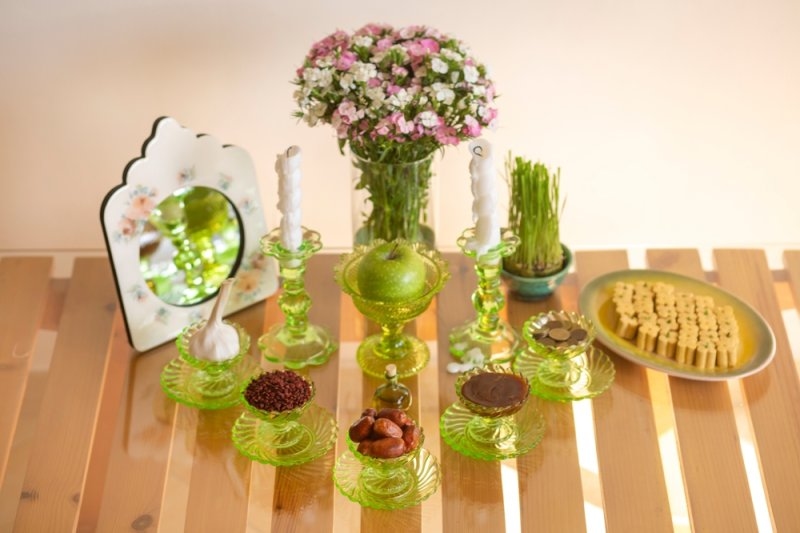
From simple household goods in ancient Persia, the images depicted are imbued with meaning and are an art form that has existed for thousands of years. They are not simply artistic decoration, but images of faith, values, and myths that characterized one of the earliest human civilizations on the face of this planet.
To learn about the meaning behind each symbol is to truly appreciate Persian history and tradition. Here are some of the many symbols seen throughout Persia, and their specific meanings.
The majority of Persian symbols are tied to religion, nature, myths, and mundane life. Below are some of the most prevalent images and what they signify.
Amongst all symbols from Persia, none is perhaps as easily recognized as the Faravahar. Derived from Zoroastrian tradition, it depicts the soul of a human being in their quest.
The image of the winged figure contains a series of symbols within itself. The three layers of feathers symbolize good thoughts, good words, and good deeds. The circle means forever, while the wings tell us to continue through life. Because this image is so powerful from both a spiritual and human development perspective, this is likely the most respected of all Persian heritage symbols.
A symbol often encountered within Persian mythology is that of the Simurgh. This legend is a very famous one in the context of Persian legends and poems.
The Simurgh is said to be a being with thousands of years of knowledge. It can usually be found protecting and aiding individuals throughout their difficult journeys in many of the epics. It symbolizes healing, as well as protection, and rebirth. In Persian artwork, the bird typically carries beautiful, colorful wings and is of a spectacular design.
The Cyprus tree is one symbol from Persia that has been embraced wholeheartedly for a multitude of reasons. Since this tree remains green and alive for a good portion of the year, it is believed that it symbolizes eternal life.
It is quite common to see the elegant tree used within gardens, Persian carpets, and decorative arts from Iran. Examples of ancient Persian symbols are aplenty, with stylized images of the Cyprus tree, indicating its representation of freedom and strength. The tree is also a symbol of balance, and a well-respected aspect of Persian cultural symbolism.
For centuries, the lion and sun symbol has been known as representing the kings of Persia as well as their national identity. This symbol represented the authority and bravery of the lion and light and prosperity for the sun.
This image was seen on royal emblems for generations, as well as banners used in battle. Even though the lion and sun have not been utilized for so long due to political changes in the country, it continues to be one of the most well-known Persian heritage symbols and stands for leadership and the former glories of Persian civilization.
Amongst the more notable Persian mythology symbols, the Homa bird is said to be a bird that flew in the sky and never touches the ground.
Legend dictates that if you passed under its shadow, you would be granted good fortune and success. For this reason, this bird is extremely closely associated with luck and prosperity.
One of the more famous of the Persian symbols is the pomegranate. With its thousands of tiny seeds, this fruit comes to symbolize fertility, prosperity, and abundance.
The fruit is typically enjoyed at holidays and family celebrations, and its beauty has also inspired numerous poets and artists to compose poems and designs relating to its divine properties. Images of the pomegranate fruit itself can be seen painted onto ceramics and fabrics, as well as incorporated into textile design, showing it as a prominent aspect of Persian iconography.
Often called the "paisley design" in other regions, this pattern, originating from Persia, symbolizes life, growth, and eternal life.
The design is essentially a flower bud enclosed by a leaf, which resembles the general shape of a cypress tree. Due to its beauty, the Boteh pattern has spread worldwide and can be seen on carpets, clothes, and many other items. It is, without a doubt, one of the most widely recognized Persian symbols.
Fish have long played a vital role in the imagery of Persia. Symbolizing movement and abundance as well as the cycle of life. Fish motifs are particularly common in traditional Persian carpets, where they are usually depicted in a circular arrangement, which stands for balance and harmony.
Perhaps the most iconic Persian art motif found within Persia itself is the lotus flower. This motif comes to symbolize purity, the creation, and spiritual growth.
It has been sculpted onto many palaces and is very commonly seen within Persian imagery due to its inherent beauty and meaning. Among the ancient Persian symbols of rebirth and spiritual development, the lotus stands out amongst its peers as one of the most cherished.
These ancient Persian palaces were often covered in statues of winged beings, often lions and bulls. Winged creatures symbolize protection and mastery by gods. They often symbolized the authority of kings and guarded them. Of all of the symbols in Persian mythology, winged animal symbols remain most interesting due to their religious meaning, as well as their representation of power.
Persian symbols continue to remain popular due to the messages that they carry with them. Symbolism representing things like spiritual growth, abundance, courage, and knowledge will always be relevant. Many ancient Persian symbols remain in modern fashion and jewelry designs, buildings, and Persian artwork. Traditions have been passed down through generations through Persian iconography. The traditional Persian symbols are a link to the vast Persian history that has remained influential.
Traditional Persian symbols have so much more to offer than decorative ones. These symbols provide great insight into the values and mythology that have survived thousands of years. They continue to carry meanings of hope and resilience from the Faravahar to the cypress and from the Simurgh to the pomegranate, proving how enduring the cultural heritage symbols of ancient Persia continue to be.
Persian symbols can most commonly be found on such items as carpets, ceramics, jewelry, textiles, architecture, and metal objects. It is these objects and forms of art that have allowed us to continue to know many traditional meanings associated with Persian symbols and keep them as a constant presence within daily life and culture.
Some symbols are tied into particular religious movements, such as the Faravahar to Zoroastrianism, while many Persian symbols derive from mythology, nature, or ancient traditions. It is the combination of various symbols, which together depict various parts of the Persian culture as opposed to one particular religion.
Birds traditionally mean intelligence and protection, as well as spiritual and natural development. Mythical creatures such as the Simurgh or Homa bird often represent healing, luck, knowledge, and a bright future; these were also incorporated in the art forms of Persian culture and are still quite evident today.
These symbols have endured because they have been passed down through traditions, stories, works of art, and architecture. These traditional meanings allowed them to carry over into the present day.
This content was created by AI